
How to Choose Your LUNOS

Looking to improve your home’s indoor air quality but not sure which LUNOS system to choose? This guide will help you understand the key differences between LUNOS HRV models and walk you through the factors that matter most—room type, wall depth, climate, filtration, and controls—so you can make an informed, confident decision.
Table of contents
1. Ventilation in Canada2. Choosing a LUNOS HRV Based on Room Type3. Wall Depth Considerations for e² series and eGO Units4. Climate Considerations and Exterior Grille Options5. Aesthetics, Sound and Air Filtration Options (interior screens)6. Control Options: Universal vs. Smart HRV Management7. LUNOS Product Comparison Table8. Need Help Choosing a Decentralized HRV System?Ventilation in Canada
Why Proper Ventilation Matters in Canadian Homes
Many homeowners experience issues with indoor air quality—certain rooms feel stale, humid, or have persistent condensation on windows during winter months. These are signs of poor ventilation.
Whether your home is well-sealed and energy-efficient or older and less airtight, imbalanced ventilation can lead to discomfort and declining indoor air quality. Proper ventilation is essential to maintaining a healthy and comfortable living environment. At Lunos Canada, we frequently encounter homeowners facing these challenges—often without realizing that ventilation may be a key contributing factor. Fortunately, LUNOS offers simple, effective solutions that restore balanced airflow and improve indoor comfort, without the need for ductwork or disruptive renovations.
What Is a Ductless HRV?
LUNOS is a ductless heat recovery ventilator (HRV), also known as a decentralized HRV. Decentralized describes where the work happens; ductless describes what’s missing. Unlike a conventional HRV, with one central unit and ducts running to every room, LUNOS units are installed directly into exterior walls, in the rooms where fresh air is most needed. They improve your home’s indoor air quality while conserving energy.
Because the system is decentralized, there is no need to retrofit an entire ducted system. LUNOS can be installed selectively—in bedrooms, bathrooms, living spaces, and basements—depending on the needs of your home.
LUNOS systems are designed to recover heat / energy, so during the cold of winter or the heat of summer, your space remains comfortable without wasting energy. They don’t rely on ductwork, and the only maintenance they require is cleaning or replacing the filters—just steady, reliable fresh air where you need it most.
How Lunos Canada Helps You Design the Right HRV Strategy
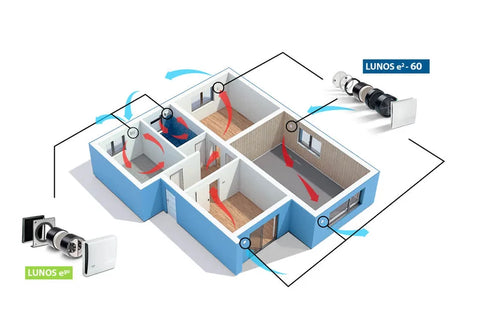
Selecting the appropriate LUNOS system begins by understanding your home’s needs. However, before addressing individual components, it is important to understand that LUNOS is best implemented as part of a ventilation strategy. The implementation is modular and highly flexible, allowing it to be tailored to suit various layouts, room types, and airflow goals.
For example, you might live in a studio or one-bedroom apartment that only needs a single pair of e² series units to ventilate the entire space. The e² series includes the original e² and the e²60 PRO, the e² with a more powerful fan. Both are paired, through-wall units for bedrooms, living areas and open-plan spaces. The e²60 PRO isn’t sold online; each setup is quoted for the project.
Or, you could be retrofitting an older two-storey home, where a mix of e² and eGO units might offer the best solution. LUNOS systems also work well alongside existing ventilation setups. If your central system doesn’t adequately serve the basement, for instance, a pair of e² units can target that specific zone—without touching ductwork.
A ductless HRV makes the most sense where ducts don’t: older homes that were never built for them, homes sealed up by a renovation, finished basements and basement suites, additions, laneway homes and tiny homes. It isn’t always the answer on its own, though. A ducted HRV is a good system, and in a home being built with room for ductwork, it can be the right choice. And having a central system doesn’t rule LUNOS out: central systems don’t always reach every room the way they were designed to, and some rooms need more fresh air than the system delivers. In single-family homes and multi-unit residential buildings alike, LUNOS can work alongside the central system as part of one ventilation strategy, filling the gaps it leaves without touching the existing ducts.

Choosing a LUNOS HRV Based on Room Type
Choosing the right LUNOS decentralized HRV depends on room type and airflow needs.


If you’re unsure how to plan your setup, get in touch with our team. We’ll help you design a system that fits your home.
Wall Depth Considerations for e² series and eGO Units
Each LUNOS unit fits a range of wall depths. Here’s what you need to know.
The e² comes in two different sizes, the short or the standard:
7½"
minimum wall depth
The short model requires a minimum wall depth of 7½ inches. It includes a 12" (305 mm) sleeve that is cut to fit between your finished interior and exterior surfaces.
10½"
minimum wall depth
The standard model requires a minimum wall depth of 10½ inches. It comes with a 19.7" (500 mm) sleeve that is cut to fit between your finished interior and exterior surfaces. If your wall is too shallow, a small surface-mounted box (interior or exterior) can be used to make up the difference.
Both e² models deliver the same airflow and core functionality. The standard version has a slightly longer heat exchange core, which results in a marginal increase in heat recovery—but the difference is minimal in real-world performance.
9½"
minimum wall depth
The eGO that we carry in Canada requires a minimum wall depth of 9½" and comes with either a 19.7" (500 mm) sleeve or a 12" (305 mm) sleeve that is cut to fit between your finished interior and exterior surfaces. If your wall is too shallow, a small surface-mounted box (interior or exterior) can be used to make up the difference. The base LUNOS eGO is a single unit and includes a Smart Control with transformer and either a Universal Hood or an Aluminum Hood.
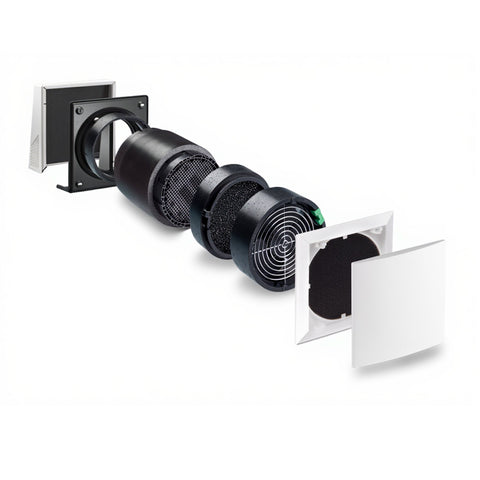
The base LUNOS e² includes a pair of units, a Universal Control with transformer, two standard plastic interior screens and two plastic exterior grilles. From there, you can configure your system based on your climate, layout, and performance preferences. These aren’t “accessories” in the traditional sense—they’re modular upgrades designed to optimize the system for your specific needs.
Climate Considerations and Exterior Grille Options
If your home is in a windy area, cold region, or especially exposed to the elements, we always recommend using either the Universal Hood or Aluminum Hood on the exterior. These provide better protection for your unit and help it perform more reliably in inclement weather.


The LUNOS eGO comes standard with the Universal Hood or Aluminum Hood, but for the e² series, you’ll have a choice between the basic plastic grille, Universal Hood, or Aluminum Hood. For most Canadian homes, we lean toward the Universal or Aluminum options—they’re worth it for the added durability and protection.
Aesthetics, Sound and Air Filtration Options for LUNOS HRVs (interior screens)
Every LUNOS unit comes standard with a plastic interior screen and washable MERV 3 filter, suitable for general residential use. For those seeking enhanced filtration—such as individuals with allergies, sensitivities to dust or pollen, or those living in urban environments—a MERV 7 pollen filter is available as a separate purchase.
For the highest level of air purification, the Hygiene Screen offers MERV 13 filtration (not available for the eGO), capturing finer airborne particles, including allergens, pollutants and wildfire smoke. The choice ultimately depends on your individual comfort level and air quality needs. Please note: the MERV 13 filter fits only the Hygiene Screen, not the standard or Comfort screens.
MERV 3
Standard filter
Included with every unit, washable
MERV 7
Pollen filter
Optional, sold separately
MERV 13
Hygiene Screen
Optional, not for the eGO
For homeowners who want fresh air and a quiet environment at the same time, LUNOS offers an optional sound-insulating inner screen, also known as the sound baffle. This inner screen helps reduce airflow noise and limits the amount of outside noise entering your home, making it a practical choice for bedrooms, home offices, or other quiet living spaces.


Control Options: Universal vs. Smart HRV Management
Finally, how hands-on do you want to be with the controls? When it comes to controls, your level of involvement depends on your preferences. On the e² series, both controls include a built-in, automatic defrost mode.


LUNOS Product Comparison Table
A quick side-by-side comparison. Figures for the e² and e²60 PRO are for a pair of units running together; figures for the eGO are for a single unit. All are measured in heat recovery mode.
| LUNOS e² | LUNOS e²60 PRO | LUNOS eGO | |
|---|---|---|---|
| Best For | Bedrooms, living rooms, open-plan areas. | Bedrooms, living rooms, open-plan areas. | Bathrooms, kitchens, enclosed rooms. |
| Airflow (regenerative mode) | 10–22 cfm 15–38 m³/h |
5–35 cfm 5–60 m³/h |
3–12 cfm 5–20 m³/h |
| Sound Level (dB) | 21–41 dB(A) | 10–48 dB(A) | 20–43 dB(A) |
| Control Type | Universal Control or Smart Control | Universal Control or Smart Control | Smart Control |
| Mounting | Through-wall, in pairs | Through-wall, in pairs | Through-wall, single unit |
| Filtration Options | MERV 3, MERV 7, MERV 13 (Hygiene Screen) | MERV 3, MERV 7, MERV 13 (Hygiene Screen) | MERV 3, MERV 7 |
For heat recovery, wall depth, power and the full figures, see our Compare page.
Need Help Choosing a Decentralized HRV System?
If you have questions about how LUNOS products might be used in your home, the Lunos Canada team is here to help. Send us your rooms and wall thickness, and we’ll suggest a setup.
Choosing the appropriate LUNOS system does not need to be complex. With a clear strategy in place, you can expect improved air quality, reduced moisture, and year-round comfort—supported by technology designed specifically for Canadian conditions.
Whether you’re improving air quality, reducing moisture, or simply making your home more comfortable, LUNOS gives you a solution that’s flexible, efficient, and built for Canadian conditions.
Want to learn more?
Explore additional articles to better understand how LUNOS systems improve air quality, comfort, and energy efficiency—whether you're renovating, building new, or just upgrading your ventilation.



Scroll sideways for more · See all articles