Introducing Lunos

Breathe Fresh. Save Energy. No Ducts

Canada’s most advanced decentralized HRV systems for homes, retrofits, and multi-unit buildings.

Shop now

Balanced Fresh Air

Continuous ventilation with synchronized airflow – no more stale rooms.

90% Heat Recovery

Preserve indoor heat while bringing in fresh outdoor air – even in winter.

Cold Climate Ready

Engineered to perform in real Canadian conditions (down to -25°C).

Whisper-Quiet

So quiet, you won’t even notice it’s running – as low as 16.5 dB(A).

Ultra-Efficient

Uses just 1.4 watts – about the same as an LED night light.

Ductless Installation

No bulky ductwork. Just a simple core hole and fast setup.

Lunos HRV Facts

What is an HRV?

A Heat Recovery Ventilator (HRV) is a ventilation system that brings in fresh outdoor air while removing stale indoor air — but instead of wasting the heat from the outgoing air, it recovers that energy and uses it to precondition the incoming air.

This creates a continuous flow of ventilation that improves indoor air quality without sacrificing comfort. In winter, it helps retain warmth. In summer, it helps preserve coolness. The result is a home that breathes — efficiently.

Lunos makes it easy to ventilate the rooms that need it most — one space at a time. Rather than forcing a one-size-fits-all approach, Lunos supports a modular ventilation strategy: systems can be installed selectively in bedrooms, bathrooms, living areas, or basements based on your home’s layout and air quality goals. The result is fresh air where it matters most — without ductwork, bulkheads, or major renovations.

At its core, an HRV is about maintaining comfort, health, and energy efficiency — by ensuring your air is always fresh, balanced, and moving.

What’s the difference between the e² and the ego?

The Lunos e² and eGO both deliver balanced, ductless heat recovery ventilation (HRV) — but they’re designed for different room types and installation needs.

Selecting the right unit begins with understanding your home’s layout and ventilation goals. More than just choosing between models, Lunos works best as part of a whole-home ventilation strategy — one that considers how each room functions and how airflow is balanced across the entire space.

  • The Lunos e² series (e² and e²60) is typically used in bedrooms, living areas, and open-concept spaces, where quiet, continuous ventilation supports everyday comfort and fresh air circulation across larger zones of the home.
  • The Lunos eGO is best suited for bathrooms, kitchens, laundry rooms, and other smaller, moisture-prone spaces, where localized airflow and humidity control are priorities — and where paired systems may not be practical.

Used together, the e² and eGO form a modular, whole-home solution that adapts to each space’s unique needs — without the complexity of ductwork.

Both deliver energy-efficient, balanced ventilation with strong heat recovery — sized and configured to suit different room types.

How does the e² work?

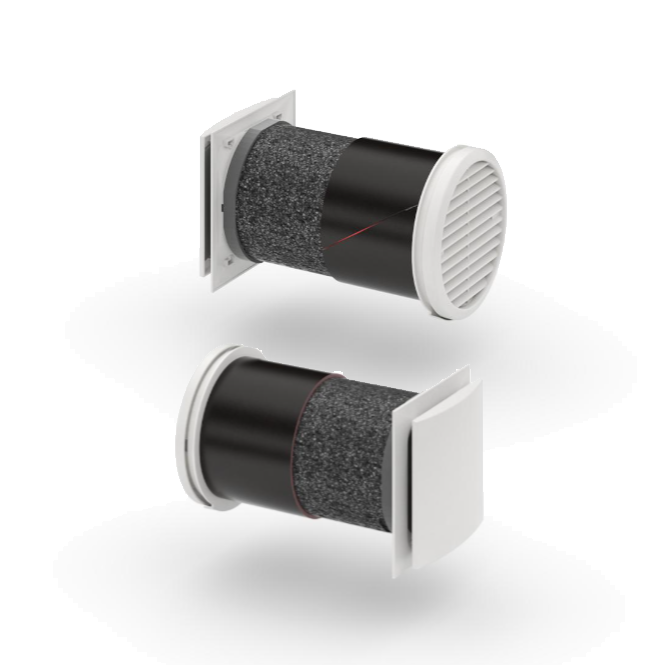
The Lunos e² is a ductless, regenerative Heat Recovery Ventilator (HRV) system installed in pairs that operate in a synchronized alternating cycle. One unit supplies fresh outdoor air while the other exhausts stale indoor air — then, at regular intervals, they reverse direction to maintain balanced airflow and enable continuous heat recovery.

Each unit contains a pbD polymer-based heat exchanger that captures and stores thermal energy from outgoing air, transferring it to incoming air during the next cycle. This next-generation material improves airflow efficiency, reduces unit weight, and requires significantly less energy to manufacture — contributing to both performance and environmental responsibility.

A compatible Lunos control device coordinates the timing of the alternating cycle and activates cold-climate defrost functionality, ensuring reliable, frost-free operation even in harsh Canadian winters.

How does the eGO work?

The LUNOS eGO is a compact, through-wall HRV designed to ventilate individual rooms — typically bathrooms, kitchens, or other enclosed, moisture-prone spaces. Unlike the e² series, which operates in pairs, the eGO uses two fans in a single sleeve to simultaneously exhaust stale indoor air and supply fresh outdoor air. This dual-channel design means it doesn’t need to be paired with another unit — making it ideal for spaces where balanced airflow and humidity control are important, but where paired units aren’t practical.

The eGO includes the same regenerative heat recovery process as other LUNOS models, with a polymer-based (pbD) heat exchanger that helps retain warmth in winter and coolness in summer.

Do Lunos HRV units filter the air?

Yes. All LUNOS HRV units include integrated filtration that cleans incoming outdoor air before it enters the room. Filter selection depends on model, indoor air quality needs, and user preference.

Standard Filtration –

Included with every unit Every e², e²60, and eGO system ships with a washable, reusable MERV 3 filter. This level of filtration is suitable for typical residential ventilation applications where outdoor air quality is moderate and occupants do not have
elevated sensitivity to airborne particulates.

Enhanced Filtration Options -

For improved particulate capture—such as pollen, dust, or general outdoor pollution—an optional MERV 7 pollen filter can be installed in both the e² series and the eGO. The pollen filter is designed to be replaced periodically
rather than washed.

High‑Efficiency Filtration (for e² only) -

For users seeking the highest available level of filtration, the e² and e²60 models support the F7 Hygiene Screen (MERV‑13 equivalent), which captures finer particulates including common allergens and urban air contaminants. This filtration option is not available for the eGO and requires a compatible internal screen in place of the standard internal grill.

Maintenance and Replacement -

Filters should be inspected periodically and serviced every six to twelve months depending on outdoor conditions and usage. MERV 3 filters can be washed and reused, whereas the MERV 7 and F7 filters should be replaced. No special
tools or HVAC technician is required—filter access is from inside the living space, and maintenance can typically be completed in minutes.

How loud are Lunos HRV systems?

Lunos ventilation systems are engineered for quiet, continuous operation, even in sensitive areas like bedrooms. Sound levels vary by model and fan speed, with measured outputs as follows:

  • Lunos e²: 17.5 – 29.4 dB
  • Lunos e²60: 18.1 – 29.9 dB
  • Lunos eGO: 16.8 – 24.0 dB

These values reflect the full range of typical regenerative mode operation (low, medium, and high speeds).

Do I need ductwork?

No. Lunos systems are decentralized and ductless, meaning they install directly through an exterior wall — no ductwork, no bulkheads, and no need for major renovations. Whether you’re retrofitting an older home, upgrading a single room, or building new, Lunos delivers balanced heat recovery ventilation without the complexity of a traditional HRV system. The result is a cleaner, simpler install — with fresh air where it’s needed most, and no ducts required.

Are they code-compliant in Canada?

Yes. Lunos units are CSA approved and thousands are installed across Canada, including government projects.

Our Lunos Decentralized HRVs

e2 Short™ HRV- 7 1⁄2" (sold in pairs)

e2 Short™ HRV- 7 1⁄2" (sold in pairs)

$1,665.00
e2 Standard™ HRV- 10 1⁄2" (sold in pairs)

e2 Standard™ HRV- 10 1⁄2" (sold in pairs)

$1,665.00
ego™ HRV (single unit)

ego™ HRV (single unit)

$1,425.00

Latest from our blog

Stay updated with our latest news and insights